Tallinn Leading Lights – Lines of Light Between the City and the Sea
There are cities that cannot be understood without the sea. And there are harbor towns that cannot be read without their lights.
Tallinn belongs to both.
Before the Lighthouses – St. Olaf’s Church as the First Landmark
As early as the 16th century, sailors navigated toward Tallinn Harbor by using the city skyline itself. The most important landmark was the tower of St. Olaf’s Church, which helped sailors judge both distance and direction. From the sea, the city itself became a signal.
But over time, maritime traffic grew denser, ships became larger, and navigation required greater precision. Purpose-built guiding lights became necessary.
Tallinn Lower Lighthouse – The White Beacon
Tallinn’s lower leading light was completed in 1806. Originally, it was square-shaped and painted white — which is why people began calling it the White Lighthouse.
In 1839, an octagonal tower top was added, giving the lighthouse a more elegant and recognizable silhouette.
Although the tower itself is only 18 meters high, it stands on a limestone cliff, placing the light 49 meters above sea level. Because of this elevated position, the light can be seen from as far as 19 nautical miles away.
During the Tsarist era, special attention was also paid to the lighthouse’s appearance. A wooden terrace and outdoor staircase were built in front of the tower — today, only the metal balcony remains.
Over the years, the lighthouse has appeared in several different colors: white, orange, yellow, and green. In 1932, it was painted red.

Fresnel Lenses and the Precision of Light
At the beginning of the 20th century, the lighthouse used Fresnel lenses imported from Paris — a technological marvel of its time that concentrated light into a precise beam visible across long distances. These lenses have survived to this day.
Although the lighthouses now operate with modern LED technology, the old system still remains both physically and symbolically — as a historical layer and a possible backup solution.
Tallinn Upper Lighthouse – The Red Beacon

About 1.5 kilometers from the lower lighthouse, the upper lighthouse was completed in 1835. The original tower was a wooden framework structure painted red with a green roof — giving rise to the name Red Lighthouse.
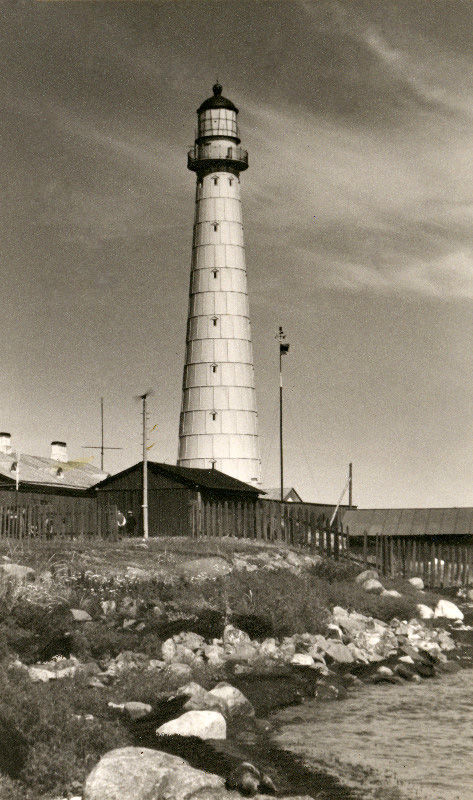
The present-day slender limestone tower, painted in black and white, was completed in 1896. It stands 40 meters high, and its light can be seen from up to 23 nautical miles away.
Together with the lower lighthouse, it forms Tallinn’s leading line — an invisible route across the sea that allows ships to enter Tallinn Bay safely while avoiding shallow waters. When the lights of both towers appeared perfectly aligned from the sea, captains knew they were on the correct and safe course toward Tallinn Harbor.

Lighthouse Compounds and Layers of Time
In the 19th century, a lighthouse was never just a solitary tower. Around it stood an entire lighthouse compound: living quarters, a kerosene storage building, a sauna, a well, a cellar, and outdoor facilities. Later, generator buildings and other technical structures were added.
Over time, these places gathered layers of history — from the Tsarist era to the Soviet period and into the present day. A former lighthouse keeper’s house may now belong to a journalist, an artist, or an ordinary family.
Even the street names of Lasnamäe still carry traces of this story: Valge Street, Punane Street, Majaka Street, and Tuletorni Street.

Part of a Maritime Cultural Landscape
Lighthouses never stand alone. They belong to a wider maritime landscape alongside harbors, piers, rescue stations, fishermen’s sheds, and coastal routes.
If these lights were ever to disappear, something greater would vanish with them. Not only a navigational mark, but a part of the city’s memory.
A similar feeling lives on in old objects — worn metal, vintage cameras, enamelware, and details shaped by time and use. If you feel drawn to old seaside towns, maritime nostalgia, and objects that have grown more beautiful with age, you may also enjoy browsing TallinnVintage — a collection of finds that would feel at home in a seaside wooden villa or an old lighthouse keeper’s house.
The Light That Remains
Tallinn’s lighthouses have changed over time, yet their essence remains the same.
They show the way.They hold the line.They remind us that you are still on course.
And sometimes — that you are already almost home.


Comments