Kuznetsov Porcelain Factory in Riga – The Story of One Family, One Factory, and Nearly a Century
When an old porcelain plate or cup bears a Kuznetsov mark on its base, that small stamp can lead back to a surprisingly rich history. Kuznetsov was not simply the name of a single factory in Riga. Behind it was a family whose enterprises grew into one of the largest porcelain manufacturers in the Russian Empire during the 19th century.
Riga held an exceptionally important place in this story.
The Kuznetsov factory began operating here in 1841 and survived the rapid industrialisation of the Russian Empire, the First World War and the evacuation of the factory, Latvia’s independence, the economic crisis of the 1930s, and the artistic revival that followed.
It was not until 1940 that this era of a family-run enterprise, spanning almost a century, came to an end.

The Kuznetsovs Before Riga
The Kuznetsov porcelain story did not begin in Riga.
The family came from the Gzhel region near Moscow, an area with a long tradition of pottery making. During the first half of the 19th century, the Kuznetsov enterprise expanded rapidly, with the family establishing and acquiring a succession of new factories.
One of these was established on the grounds of Dreiliņmuiža near Riga, in what is now the Ķengarags district.
In 1841, Sidor Terentyevich Kuznetsov founded the S. T. Kuznetsov Porcelain and Faience Factory there – the first factory of its kind in the Baltic region.
The location was no coincidence.
At the time, Riga was part of the Russian Empire and an important port and trading city. Although many of the raw materials needed for porcelain production were not available locally, the port and, later, the railway made it possible to bring in materials from afar and transport finished goods to major markets.
The first skilled workers were not local either. They came from the Moscow Governorate, the Gzhel region and the Kuznetsovs’ Dulyovo factory, bringing with them their porcelain-making skills and traditions.
At First, the Factory Did Not Produce Porcelain
Today, the Kuznetsov name may seem inseparable from porcelain, but during its first decade the Riga factory did not produce porcelain at all.
The first products were made in 1843, and between 1841 and 1851 the factory mainly produced semi-faience.
The change came in 1851. Following the completion of two new production buildings, porcelain production also began in Riga.
From that point on, the small factory began to develop into a major industrial enterprise.
Matvei Kuznetsov and the Factory’s Rapid Growth
In 1864, Sidor Kuznetsov died, and his son Matvei took over the business.
He was only 18 years old at the time.
Porcelain production, however, was already familiar to him. His father had sent Matvei to Riga at the age of 15 so that he could gain practical experience in both porcelain making and the management of a large factory. He also studied at the Riga Commercial School.
Under Matvei, the Kuznetsov enterprise entered a period of remarkable growth.
By 1870, the Riga factory already employed 525 people and operated 11 kilns. Its annual porcelain production was valued at 130,000 roubles, while faience production was worth 150,000 roubles. Fourteen years later, these figures had roughly doubled.
In 1871, the company became known as the M. S. Kuznetsov Porcelain and Faience Company.
Raw materials arrived at the factory from other parts of the Russian Empire as well as from Germany, the Netherlands, France and Scandinavia. Coal was imported from England.
The finished tableware travelled in the opposite direction.
It was sold in Riga and throughout the Russian Empire and exported to countries including England, the Netherlands and the United States.
Kuznetsov porcelain had already become an international commodity.
The factory’s production also reflected the fashions of its time. The forms and decoration of M. S. Kuznetsov’s faience and porcelain clearly displayed the influence of Art Nouveau in the early 20th century. One striking example is “Iris” – a dinner service with a distinctly Art Nouveau design, first produced by Villeroy & Boch around 1900 and soon afterwards added to the Kuznetsov factory’s range.


A Porcelain Empire
In 1887, Matvei Kuznetsov united the family’s factories into one large company – the M. S. Kuznetsov Company for the Production of Porcelain, Faience and Majolica.
Its headquarters were in Moscow, and in addition to Riga, the company included major factories in Dulyovo, Verbilki and elsewhere.
The Riga factory became part of a vast industrial empire.
By the turn of the century, the scale of production was enormous.
In 1908, the Riga factory produced more than 22 million ceramic items: around 11.4 million pieces of porcelain, 3.7 million pieces of faience and more than 7 million pieces of semi-faience.
By 1908, the factory employed 2,650 people.
This was no longer a small craft-based manufactory. The Kuznetsov factory had become one of Riga’s major industrial enterprises.
Tableware for Every Table
One of the reasons for the Kuznetsovs’ success was the exceptionally wide range of their products.
The factory did not produce only expensive decorative porcelain for wealthy customers. It also manufactured everyday cups, plates, jugs, bowls, serving dishes and table services in enormous quantities.
Kuznetsov tableware could be found both in affluent urban homes and manor houses, as well as in ordinary households.
At the same time, the factory also produced more elaborately decorated and luxurious pieces.
The Riga factory’s production in the early 20th century reflected the fashions of the period. Art Nouveau influenced both the forms and decoration of tableware, with plant motifs, flowing lines and ornamental surfaces appearing even on industrially produced porcelain.
As a result, pieces bearing the Kuznetsov name vary enormously – from simple white everyday tableware to richly gilded and hand-painted porcelain.

1915 – Everything Comes to a Halt
The First World War abruptly interrupted the factory’s development.
In 1915, as the front approached Riga, production was halted. The factory’s equipment, raw materials and finished goods were evacuated to other Kuznetsov factories in Russia. Many workers and their families left with them.
The factory itself was severely damaged during the war. Some of its buildings were completely or partially destroyed. The enterprise, which only a few years earlier had employed more than two and a half thousand people, was left in ruins.
At the same time, the world in which the Kuznetsovs’ industrial empire had been built was disappearing.
In 1917, the Russian Revolution completely changed the fate of the Kuznetsov family. After the Bolsheviks came to power, private enterprises gradually came under state control, and in 1918 the porcelain factories owned by the Kuznetsov family in Soviet Russia were nationalised. The family lost the factories that several generations had built and expanded into one of the largest porcelain enterprises in the Russian Empire.
Meanwhile, events in Riga were taking a very different course. In 1918, the independent Republic of Latvia was proclaimed, and the Riga factory remained outside Soviet Russia. As a result, it became the only factory from the Kuznetsovs’ former industrial empire to remain in the family’s ownership.
And this is precisely what makes the history of the Kuznetsov factory in Riga so remarkable.
In 1921, several members of the Kuznetsov family settled in Riga. Members of the once-powerful industrial dynasty no longer arrived as owners of an entire factory empire – their enterprises in Russia had been lost, and the war-damaged Riga factory had to be rebuilt. Family members themselves took part in both the management and day-to-day operation of the business: Georgy Kuznetsov served as commercial director, while his brother Sergei managed the production department.
The Riga factory therefore became more than simply one surviving Kuznetsov factory. It became the place where the family’s nearly century-old porcelain tradition could continue after the collapse of both the Russian Empire and the family’s industrial empire – now in the independent Republic of Latvia.
Kuznetsov in Independent Latvia
After the war, production had to be rebuilt almost from scratch.
The factory resumed operations in the 1920s, and in 1922 it operated as a registered company under the name M. S. Kuznetsov Porcelain, Faience and Earthenware Factory Joint-Stock Company.
The Riga factory now found itself in a very different position from the one it had occupied before the war.
The vast Russian market of the past had disappeared. The family’s other factories were located in Soviet Russia and had been nationalised.
The Riga enterprise, however, remained in the hands of the Kuznetsov family.
It became the only former Kuznetsov factory to continue operating under the Kuznetsov name during the interwar period.
This is one of the reasons why Kuznetsov porcelain made in Riga during the 1920s and 1930s is so fascinating today.
It was no longer simply one branch of a vast enterprise within the Russian Empire.
The Riga factory had to find a new identity of its own.
An Old Industry Meets a New Latvia
During the 1920s, and particularly the 1930s, two worlds began to meet in Kuznetsov production.
On one side was a long family tradition of porcelain making, established forms and extensive experience in large-scale production.
On the other was the young Latvian state, with its own culture, national identity and rapidly developing modern art.
Images of Latvian cities, traditional costumes, national ornament and local motifs began to appear on porcelain.
At the same time, new European artistic movements, including Art Deco, found their way into the designs.
The interwar Riga period would later come to be regarded as one of the most artistically interesting chapters in the history of Kuznetsov porcelain.




A Severe Economic Crisis
Success, however, did not come easily.
The global economic crisis that began in 1923 also affected the Kuznetsov factory, and the years 1929–1933 were particularly difficult for the company. In 1929, engineer Mārtiņš Kalniņš, who had experience in the chemical industry, was appointed to manage the factory.
The company was reorganised, and in 1934 it became the joint-stock company M. S. Kuznetsov – Porcelain, Faience and Earthenware Factory.
At the same time, a distinctly Latvian national character became increasingly evident in the factory’s production.
This did not simply mean adding national ornaments to existing forms of tableware. Designs by professional artists increasingly became part of the factory’s production, and porcelain evolved from being solely an industrial product into a medium for artistic expression as well.
The 1930s – The Golden Age of Kuznetsov in Riga
During the second half of the 1930s, pieces were produced in Riga that differed markedly from the mass-produced wares of the 19th century.
Everyday table services and household wares continued to be produced, but alongside them appeared decorative plates, vases, figurines and artist-designed pieces.
One example is the 1938 decorative plate “Tautu pāris” – “Folk Couple” – designed by Vilis Vasariņš and painted by Ivan Laminskis.
The same period also produced pieces such as the elegant “Moka / Barbara” tea and coffee service and artistically painted vases.
Latvian motifs existed side by side with Art Deco, stylised botanical ornament and other European design trends of the 1930s.
The Kuznetsov factory had become a place where a nearly century-old industrial tradition met contemporary Latvian design.

The Mark on the Base Tells the Story of an Era
The marks on the base are exceptionally important when dating Kuznetsov porcelain.
During the Russian Empire period, one of the marks used featured the double-headed eagle. After Latvia gained independence, the factory marks changed as well.
Pieces from the 1920s and 1930s may bear Kuznetsov marks referring to Riga, while examples from the 1930s can also be found with the inscription KUZŅECOVS LATVIJĀ.
Therefore, the name “Kuznetsov” on the base of an object does not automatically mean that the porcelain was made in Russia.
The piece may instead have been made in Riga – and, in some cases, during the period of the independent Republic of Latvia.
The factory mark, together with the form and decoration of the piece, can often help determine which period of Kuznetsov history it belongs to.
1940 – The End of an Era
In 1940, the Soviet Union occupied and annexed Latvia.
The Kuznetsov factory was nationalised.
This brought to an end nearly a century of the Kuznetsov family business in Riga, which had begun with the factory founded by Sidor Kuznetsov in 1841.
The factory itself did not disappear.
Porcelain production continued there, but under a different name, a different economic system and a different state.
The former Kuznetsov factory later became one of two historic porcelain manufacturers whose merger created the Riga Porcelain Factory known to us today.
But that is another story.
Porcelain as a Historical Document
Today, it is easy to look at an old Kuznetsov cup simply as a beautiful vintage object.
But there may be much more behind it.
One piece may come from a major industrial enterprise of the Russian Empire. Another may have been made in a factory rebuilt after the First World War. A third may belong to one of the most fascinating periods of design culture in independent Latvia during the 1930s.
That is why it is always worth turning old porcelain over.
A small mark on the base may be the first clue to a story that began on the outskirts of Riga in 1841 and continued for almost an entire century.



What to Collect from Kuznetsov Porcelain?
For me, the appeal of Kuznetsov porcelain lies not only in the history of the factory or in rare artist-designed pieces. Everyday tableware can be just as fascinating – the pieces that once stood on dining tables, in cupboards and sideboards.
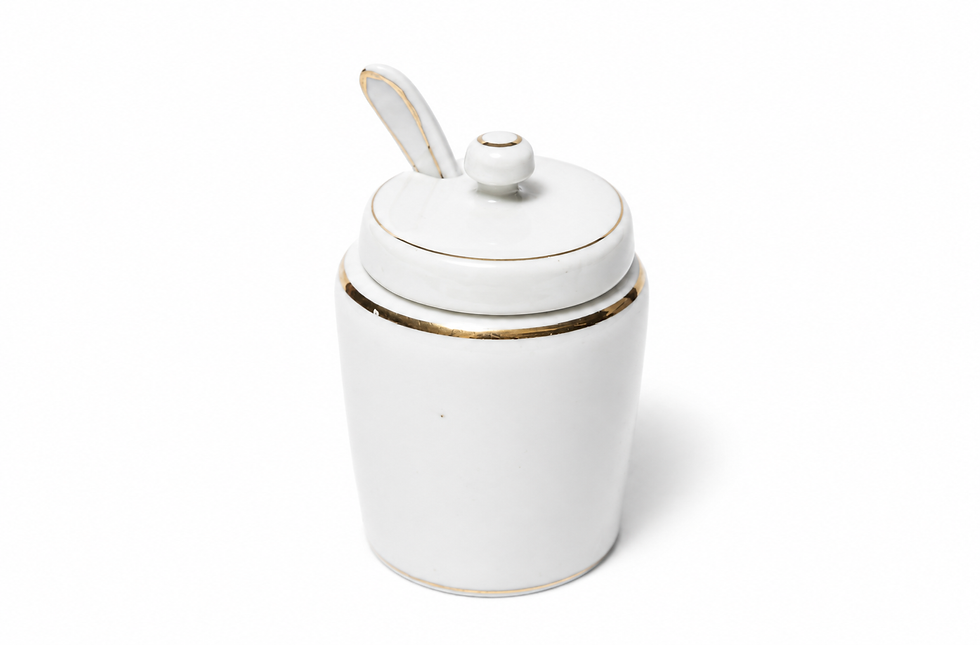
I particularly like white porcelain with fine gold bands. It is simple yet elegant and easy to combine with porcelain from different periods. And just look at how many different forms even the simplest white teapots with gold bands can take – each one has its own slightly different shape, proportions and character. Blue-and-white porcelain has an entirely different look, with its strong contrast still appearing fresh in contemporary interiors.
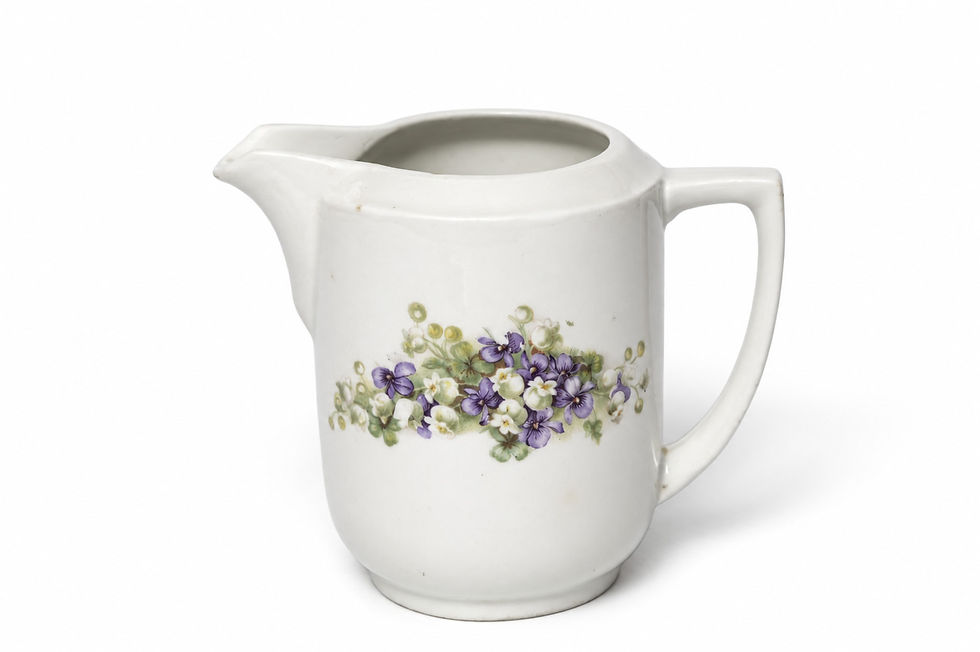
Vintage floral decorations form a world of their own – violets, lily of the valley and other small romantic flowers. Equally charming are dessert plates with fruit motifs, decorated with cherries, plums, pears, grapes and other colourful fruits. It is precisely these floral and fruit patterns that give old porcelain its distinctive nostalgic character, something rarely found in modern tableware.
Ivory-coloured porcelain is also worth collecting. Its warm, creamy tone is softer than pure white, and when combined with gold details, the result can be particularly elegant.
There is no need to collect an entire dinner or tea service. A single teapot, cream jug, soup tureen, serving platter or beautiful cup can be a decorative piece in its own right. Old soup tureens, for example, can also be given a wonderful new role – I use mine as cachepots for potted plants. In this way, old porcelain can become part of a contemporary home rather than remaining hidden away in a display cabinet.


Comments