The Art of Enamel Jewellery – From Imperial Russia to Vintage Brooches
Smooth, lustrous surfaces, deep colours and delicate floral and ornamental patterns are created by combining glass enamel with metal – a technique with a history stretching back thousands of years.
Enamel has been used to decorate gold and silver, combined with pearls, diamonds and coloured gemstones, and employed in everything from modest pieces of jewellery to sumptuous jewels made for the royal courts of Europe.
One of the most remarkable chapters in the history of enamel was written in Russia in the late 19th and early 20th centuries.
What is enamel?
Jewellery enamel is a finely ground, glass-like material that is applied to a metal surface and fired at a high temperature. In the heat, the enamel fuses with the metal, creating a strong, smooth and often brilliantly coloured surface as it cools.
This is what distinguishes traditional enamel from simply painted metal. The colour is not merely painted onto the surface – it is a glassy layer fused to the metal through heat.
Precious metals, particularly gold and silver, are especially well suited to enamelling, although enamel has also been used on copper and other metals. In jewellery, the technique allowed goldsmiths to introduce something gemstones alone could not provide: broad areas of pure colour, translucent layers, painterly images and extraordinarily intricate ornamentation.
Over the centuries, a number of different enamelling techniques developed.
In cloisonné, fine metal wires or strips are used to create small compartments on the metal surface, which are then filled with enamels of different colours.
In the champlevé technique, the design is recessed directly into the metal surface and the resulting hollows are filled with enamel.
Painted enamel transforms the metal surface into something resembling a miniature canvas, allowing flowers, portraits, landscapes and ornamental designs to be depicted in enamel colours.
And then there is the technique that became particularly celebrated in the goldsmithing of Imperial Russia: guilloché enamel.
When Metal Glows Beneath the Enamel
With guilloché enamel, a regular geometric pattern – rays, waves, spirals or fine lines – is engraved into the metal surface before the enamel is applied. A transparent or translucent layer of enamel is then laid over it.
The result is a surface that seems to move in the light.
The enamel gives the object its colour, while the engraved pattern in the metal remains visible beneath it. It is this interplay of light, metal and translucent colour that gives guilloché enamel its characteristic depth.
By the late 19th century, the goldsmiths' workshops of St Petersburg had brought this technique to an extraordinary level of refinement.
The most famous name among them was Carl Fabergé.
Fabergé and the Russian Imperial Court
Today, the name Carl Fabergé is associated above all with the celebrated Imperial Easter Eggs, but the Fabergé workshops created far more: brooches, pendants, bracelets, necklaces, cigarette cases, clocks, picture frames, miniature flower arrangements and countless other luxury objects.
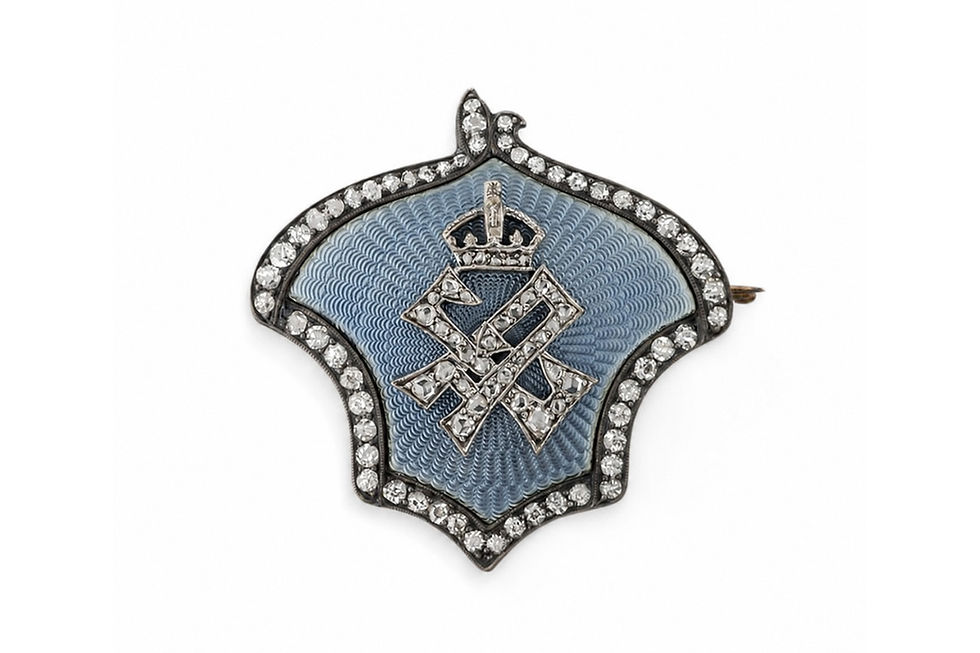
In 1885, Fabergé became an official supplier to the Russian Imperial Court. That same year, Emperor Alexander III commissioned an Easter gift from Fabergé for his wife, Empress Maria Feodorovna.
This marked the beginning of one of the most celebrated traditions in the history of jewellery.
After the death of Alexander III, Nicholas II continued the tradition of commissioning Imperial Easter Eggs. He presented them both to his mother, Maria Feodorovna, and to his wife, Alexandra Feodorovna.
But in the world of the Romanovs, enamel was not reserved for Easter eggs alone.
Enamel was an integral part of the luxurious goldsmithing and jewellery of the period.

Gold, Silver, Pearls and Enamel
In the work of Fabergé and other Russian goldsmiths, enamel appears in a remarkable variety of combinations.
Enamel could cover a surface of gold or silver and be set alongside diamonds, pearls, rubies and other gemstones. It was also sometimes combined with nephrite, jadeite or rock crystal.
It was precisely this contrast between materials that gave these objects their richness.
Cool, translucent enamel could sit beside warm gold. Pale pink or blue enamel might be edged with a row of tiny diamonds. The petals of a flower could be made of enamel, its stem of gold, with a pearl or gemstone set at its centre.
The collection of The Metropolitan Museum of Art includes objects from the Fabergé workshops in which gold, silver, pink guilloché enamel and a pearl, for example, come together in a single small object.
This clearly shows that enamel was not a less expensive substitute for gemstones.
On the contrary – in the finest jewellery, the two were used side by side.
Flowers of the Empresses
Flowers were far more than mere decoration in late 19th-century jewellery. They carried their own symbolism, and floral motifs could evoke personal memories and convey messages.
Enamel was exceptionally well suited to this world.
Empress Alexandra Feodorovna loved lilies of the valley. Fabergé's famous Basket of Lilies of the Valley combines gold, silver, pearls, diamonds and nephrite. Although it is not a wearable piece of jewellery, it beautifully illustrates how jewellers sought to transform fragile flowers into something permanent.
Nature became a jewel.
In the Fabergé workshops, enamel flowers, leaves and berries were created alongside gold, silver, pearls and gemstones. The same approach found its way into jewellery – brooches, pendants and other small wearable objects.
The brooch was particularly well suited to this.
The Brooch as a Miniature Work of Art
A brooch has one fascinating advantage over many other forms of jewellery: its shape does not have to follow the form of the wrist, finger or neck.
The goldsmith could use almost the entire small surface to create a composition.
A brooch could therefore take the form of a flower, a branch, an insect, a bird, a coat of arms, a monogram or an abstract ornament.


Enamel made it possible to add colour to these forms.
Green leaves, blue flowers, red berries and multicoloured butterfly wings did not necessarily require dozens of different gemstones. A jeweller could create them directly on the metal using glass enamel.
In the most luxurious brooches, enamel and precious metals were combined with gemstones. In more modest pieces, it was the enamel itself that transformed a small metal object into something colourful and eye-catching.
From Imperial Luxury to Everyday Jewellery
Jewellery underwent a major transformation during the 20th century.
The art of enamelling did not disappear with the imperial courts. On the contrary, colourful enamel jewellery became accessible to an increasingly wider audience.
Alongside gold and platinum, silver, copper, brass and various metal alloys came into wider use. Enamel jewellery was no longer limited to unique luxury pieces created by master jewellers.
It also became a fashionable accessory.
Enamel was particularly well suited to brooches.
Nature-inspired motifs became exceptionally popular in 20th-century brooches: daisies and roses, lilies of the valley and violets, leaves, berries, butterflies, dragonflies, birds and entire bouquets of flowers.
Some were made of silver, others of brass or different metal alloys. Some featured translucent enamel that allowed the metal beneath to shimmer through, while others were covered in completely opaque enamel, gleaming almost like coloured porcelain.
In terms of the value of their materials and the complexity of their craftsmanship, these pieces could be worlds apart from the jewels of the Romanov court.
Yet the underlying idea remained surprisingly similar.
To take metal and give it new life through light and glass-like colour.
This is part of what makes an old enamel brooch so fascinating to hold.
It may be a small and modest piece of jewellery, made decades after the end of the Russian Empire. Yet behind its decorative technique lies a much longer tradition of craftsmanship – a world in which goldsmiths and jewellers learned to bring together metal, glass, colour and fire.
And perhaps this is where the particular charm of vintage enamel jewellery lies.
These small, colourful objects are fragments of a much larger story of jewellery.


Comments